Corporate
Security for offices and multi-tenant buildings
Access control, surveillance, ANPR and one joined-up view of the building, for corporate offices and multi-tenant estates where hybrid working has changed the threat picture.
Nobody knows who belongs any more
Your building was secured on the assumption that the same people came in five days a week and reception knew their faces. October 2025 ONS figures show that 27-28% of workers are now in a hybrid arrangement. Attendance now changes daily, desks are shared. Nobody is sure who works there, who is visiting, and who simply walked in.
One polite gesture and someone is through the door
Someone in business casual with a phone to their ear tailgates a pass holder. Nobody challenges them because there are fewer people around, and those who are there assume reception has cleared them, or that they work for another tenant. Then an item or laptop goes missing and nobody can say for certain who was on the floor at the time.
Each tenant wants control of their own floors
Every tenant wants control of its own floors, its own joiners and leavers and its own reporting. They all share the lobby, the lifts, the loading bay and the car park. That calls for access control and CCTV that are reliable, auditable and clearly divided along the line between landlord and tenant. It also calls for a decision on who controls the data each system holds.

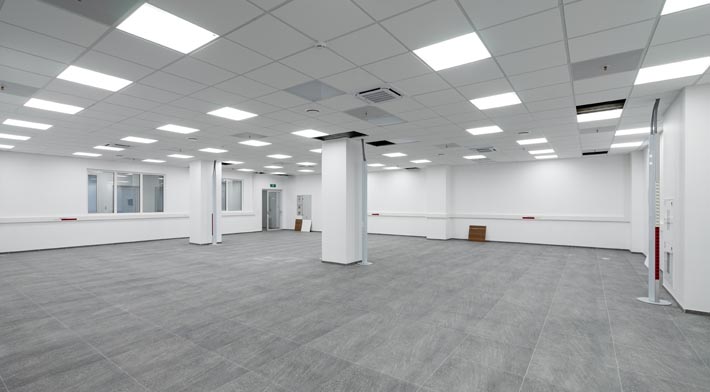
Empty floors, and the insurance behind them
Space between lettings or waiting on a fit-out is the part of the building nobody walks through. Trespass, metal theft and vandalism start there. Most commercial policies treat a unit as unoccupied after about thirty days, and cover is then usually cut back to a short list of major perils. Insurers attach conditions alongside that, covering inspections, isolating services and agreed security measures.
How ATEC protects the corporate sector
The system identifies who should be there
Every person carries a credential, every door is told which credentials open it and the building keeps a live picture of who is in it. That picture is only as good as the readers behind it. With a reader on the way out, and anti-passback to stop one card being handed back through the barrier, the system knows who came in and who is still there.
Close the gap behind the pass holder
Speedgates are built so that one credential admits one person, and they stop the casual follower. Analytics watch for the second body slipping in behind the first, and the alert reaches your team with footage attached while they are both still in the lobby. Gates on an escape route also have to release on a fire alarm.
Every tenant runs their own doors
Each tenant administers its own floors, adds and removes its own people and sees its own reporting, while the lobby, lifts and car park stay under your control as the estate owner. A leaver loses access the moment their record is disabled. Multi-factor sign-in is what protects the administrator accounts holding those permissions, for both estate owner and tenants.
Cover the unoccupied spaces
Vacant floors, plant rooms and service yards get detection and analytics tuned to keep false activations down, with thermal cameras covering unlit areas. Alerts land in a control room or at an alarm receiving centre. That, on a system installed and maintained by a certificated company, is what an insurer wants to see written down against an unoccupied unit.
ATEC articles
We hold ourselves to the highest standards
At ATEC we hold ourselves to the rigorous requirements of the industry’s leading certification bodies. Our accreditations are audited on a regular basis and we continually invest to keep our certifications up to date.